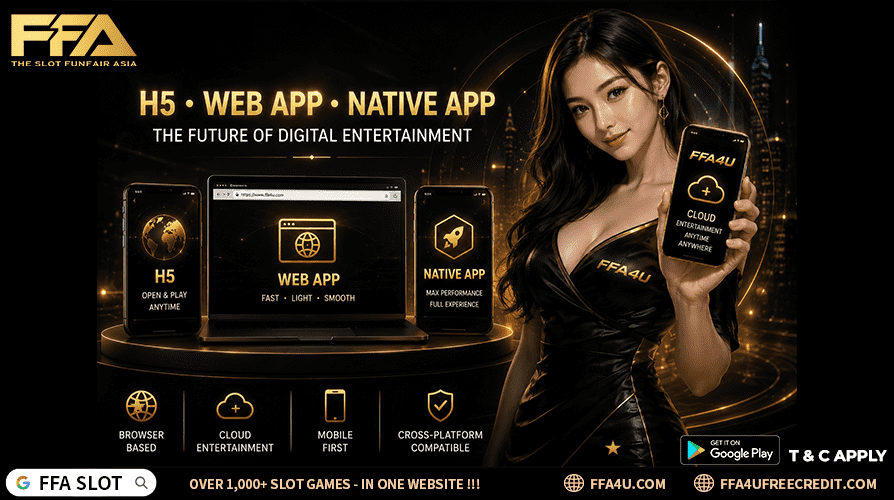
H5, Web App & Native App: Understanding the Future of Digital Entertainment Technology
Quick Contents
- Introduction: Why Platforms Are Moving Away from Traditional Apps
- What is H5?
- H5 Features
- What is Web App?
- Web App vs Traditional Website
- Why Companies Prefer Web Apps
- Why PWA Is Becoming Popular
- What is Native App?
- Biggest Advantages of Native Apps
- Drawbacks of Native Apps
- H5 vs Web App vs Native App
- Who Should Use H5?
- Who Should Use Web App?
- Who Still Needs Native App?
- Why Are More Platforms Choosing H5?
- H5 Fits the Mobile First Era
- Why Web App Is Considered the Future
- Future Digital Entertainment Technology Trends
- About FFA4U
- FAQ
- Conclusion
- Disclaimer
Introduction: Why Are More Platforms Moving Away from Traditional Apps?
Over the past decade,
the development logic of digital entertainment platforms was actually very simple:
Build an App,
Ask users to download it,
Then continuously release updates.
Because of this,
whether it is:
- Gaming platforms
- E-commerce platforms
- Social media
- Entertainment services
almost every platform invested heavily in:
However,
by 2026,
this model is gradually changing.
More and more companies are moving towards:
- H5 Platforms
- Web Apps
- Progressive Web Apps (PWA)
- Cloud-Based Services
Because users increasingly prefer:
Instead of:
This shift from Download First to Open First is changing the future direction of digital entertainment platforms.
What is H5?
H5,
or more accurately:
is essentially:
Users only need:
- A smartphone browser
- Internet connection
to access the platform instantly.
There is no need to:
- Download APK
- Install App
- Update manually
H5 Features
1. Lightweight Experience
Users simply click and enter.
No installation required.
The entry barrier is extremely low.
This is also one of the main reasons why more entertainment platforms are adopting H5.
2. Automatic Updates
Whenever the platform updates,
users automatically see the latest version.
No update button.
No reinstall.
3. Cross-Platform Compatibility
H5 works across:
- Android
- iPhone
- Tablet
- Desktop
This means:
companies only need to maintain:
Instead of:
- Android App
- iOS App
4. Lower Development Cost
Maintaining:
is generally cheaper
than developing multiple native applications.
Therefore,
many digital entertainment companies are adopting:
What is Web App?
Many people assume:
But actually,
they are related,
yet not exactly the same.
What Exactly is a Web App?
A Web App can be described as:
It still runs inside a browser.
But it supports more advanced features.
For example:
- Full Screen Mode
- Push Notifications
- Offline Cache
- Background Sync
- Install to Home Screen
Which means:
its experience becomes much closer to:
Web App vs Traditional Website
Traditional websites mainly provide:
- Reading content
- Viewing information
- Static pages
Web Apps focus more on:
- User interaction
- Dynamic content
- Real-time updates
- Immersive experience
They are no longer ordinary websites.
Instead,
they form:
Why Companies Prefer Web Apps?
Because Web Apps combine:
The convenience of H5
and
The experience of Apps.
Companies can:
- Reduce development cost
- Shorten launch cycles
- Improve compatibility
- Avoid App Store restrictions
Why is PWA Becoming Popular?
Besides H5 and Web App,
one of the most discussed technologies in recent years is:
PWA is essentially:
H5 + Web App + Native App Experience
It keeps the convenience of websites,
while offering:
- Add to Home Screen
- Push Notification
- Offline Cache
- Service Worker
- Background Sync
Users can even:
install the website directly
onto their smartphone home screen.
Advantages of PWA
Low Installation Barrier
Users don't need:
- Google Play
- Apple App Store
They simply:
Faster Updates
Every update happens automatically.
No:
- Manual update
- Reinstall
- App Store approval
Near-Native Experience
Modern PWAs support:
- Full screen mode
- Smooth animations
- Offline cache
- Push notifications
Many users can hardly tell the difference between:
and
PWA bakal menjadi salah satu komponen utama dalam ekosistem Web App masa depan.
What is Native App?
Native App refers to:
For example:
- Facebook App
- Instagram App
- TikTok App
- Grab App
Users need to:
- Download
- Install
- Update
before using them.
Biggest Advantages of Native Apps
Best Performance
Native Apps run directly on:
- Android
- iOS
Therefore:
- Animations
- Graphics
- Response speed
are generally superior.
Full Hardware Access
Native Apps can access:
- Camera
- GPS
- Bluetooth
- Fingerprint
- NFC
This is still one of their biggest advantages.
Stronger Offline Capability
Even without internet,
many features remain available.
This is why:
- Large mobile games
- Banking Apps
- Navigation Apps
still rely heavily on:
Drawbacks of Native Apps
Although powerful,
Native Apps also have several limitations.
Requires Installation
Many users simply do not want:
to download
another:
Frequent Updates
Users may need to:
- Update regularly
- Reinstall
- Deal with OS restrictions
App Store Restrictions
Platforms need approval from:
- Google Play
- Apple App Store
The process can be:
- Time-consuming
- Expensive
- Complex
Therefore,
many companies are asking:
Do we really need an App?
H5 vs Web App vs Native App
| Features | H5 | Web App | Native App |
|---|---|---|---|
| Installation Required | ❌ | ❌ | ✅ |
| Update Method | Automatic | Automatic | Manual |
| Mobile Compatibility | High | High | High |
| Performance | Good | Very Good | Excellent |
| Push Notification | Partial | Supported | Full Support |
| Offline Capability | Weak | Moderate | Strong |
| Development Cost | Low | Medium | High |
| Maintenance Cost | Low | Medium | High |
Who Should Use H5?
If a platform emphasizes:
- Fast access
- Mobile compatibility
- Content updates
- Lower entry barrier
H5 will be a very good choice.
Who Should Use Web App?
If a platform emphasizes:
- User interaction
- Instant notifications
- Dynamic functions
Web App usually has stronger advantages.
Who Still Needs Native App?
If a platform needs:
- High-performance graphics
- AR
- GPS
- Bluetooth
- Hardware access
Native App still has clear advantages.
Why Are More Platforms Choosing H5?
Because:
user behavior has changed.
In the past:
people were willing to:
Today:
many users prefer:
Especially younger users prefer:
- Faster access
- Less storage usage
- Fewer installed Apps
- Better compatibility
tanpa perlu memuat turun aplikasi yang besar.
Lower User Acquisition Cost
Traditional App flow:
The process is complicated.
H5 flow:
Fewer steps mean:
lower user drop-off.
More Suitable for Overseas Markets
Different countries may have:
- Different Android versions
- Different App Store policies
- Different smartphone brands
H5 only requires:
Therefore,
more international entertainment platforms are adopting:
H5 Fits the Mobile First Era
With:
- 4G expansion
- 5G growth
- Faster browsers
- Cloud technology
H5 has become increasingly powerful.
Many H5 platforms today provide experiences that are:
Platforms can:
- Reduce development costs
- Release updates faster
- Lower maintenance expenses
- Improve cross-platform compatibility
Therefore,
more digital entertainment platforms are embracing:
Why Web App Is Considered the Future?
Many technology companies believe:
the future may not belong to:
Instead,
it may belong to:
Because modern browsers now support:
- Push Notifications
- Background Sync
- Offline Cache
- Install to Home Screen
- Service Workers
These were once:
exclusive App features.
Therefore,
the future may look like:
with:
providing:
near-native experiences.
Future Digital Entertainment Technology Trends
In the coming years,
digital entertainment may evolve toward:
H5 First
Open instantly.
No installation.
Web App Ecosystem
Browsers becoming:
more App-like.
Cloud Entertainment
Users no longer need:
to download large files.
Everything becomes:
Mobile First Design
Platforms prioritize:
- Mobile UI
- H5 Performance
- Faster Loading
- Better UX
Because:
smartphones are now:
AI Personalization
Future platforms may optimize automatically based on:
- User interests
- Usage habits
- Browsing behavior
To provide:
- Personalized content
- Smarter recommendations
- Better interactions
About FFA4U
FFA4U continuously explores:
- Digital Entertainment Trends
- H5 Technology
- Web App Ecosystem
- Mobile Internet Innovation
We are committed to sharing:
industry insights,
technology analysis,
and user experience research.
As H5,
PWA,
and Cloud Services
continue to evolve,
digital entertainment is moving toward:
- Lightweight Experiences
- Instant Access
- Open Ecosystems
- Mobile-First Innovation
We believe:
great platforms require not only:
stable technology,
but also:
- Better User Experience
- Strong Security
- Cross-platform Compatibility
- Continuous Innovation
Whether it is:
H5 First,
Web App Ecosystem,
or
Cloud Entertainment,
FFA4U will continue following
the future of digital entertainment
and deliver
more professional,
more insightful,
and more forward-looking content.
Official Website:
FAQ: H5, Web App & Native App
Are H5 and Web App the same?
Not exactly.
H5 refers to web technology.
A Web App is:
A more app-like web application with advanced functions.
Does a Web App need to be downloaded?
Usually no.
Users can access Web Apps directly through a browser.
Some Web Apps can also:
Install to smartphone home screen.
What is PWA?
PWA stands for:
Progressive Web App.
It combines:
- H5
- Web App
- Native App
allowing websites to offer:
an App-like experience.
Will Native Apps disappear?
Not in the short term.
But in the future,
more services may prioritize:
- H5
- Web App
Why are more platforms choosing H5?
Because:
- No installation required
- Automatic updates
- High mobile compatibility
- Lower maintenance cost
It fits perfectly with:
Is H5 secure?
Reputable H5 platforms usually adopt:
- HTTPS
- SSL Encryption
- Cloud Security
- Multi-layer Protection
Users should:
prioritize platforms with:
good reputation,
mature technology,
and transparent operation.
Conclusion: The Future Belongs to Lighter and More Open Digital Entertainment Platforms
In the past,
the core idea of digital platforms was:
Users had to:
Download,
Install,
Update.
But the future is moving toward:
Open the browser,
and start experiencing instantly.
With:
- H5 maturity
- Web App growth
- PWA popularity
- 5G expansion
- Cloud services
Future digital entertainment platforms will become:
- Lighter
- More Instant
- Smarter
- More Mobile
For modern users,
the most important question is no longer:
Does it have an App?
But rather:
Can I get a fast, secure and smooth experience?
And perhaps,
this is exactly:
Disclaimer
This article is intended solely for discussions on:
- Digital platform technologies
- Internet development
- Mobile application trends
It does not constitute:
- Investment advice
- Commercial advice
- Entertainment platform recommendations
Different platforms may adopt different technical architectures,
and the actual experience may vary according to:
- Devices
- Network conditions
- Browser compatibility
Pengguna dinasihatkan supaya memilih platform yang mempunyai reputasi baik, mengutamakan keselamatan digital, dan sentiasa mendapatkan maklumat melalui saluran rasmi.