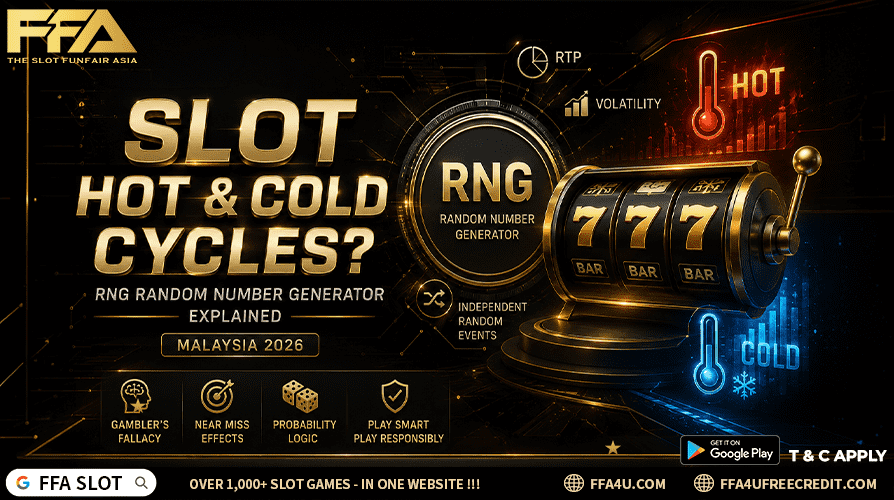
Do Slot Games Really Have “Hot & Cold” Cycles? RNG Random Number Generator Explained
Quick Contents
- Do Slot Games Really Have Hot & Cold Cycles?
- What is RNG?
- How Does RNG Work?
- Do Slot Games Really Have Hot & Cold Periods?
- Why Games Feel Cold
- Hot Period Psychology
- Near Miss Effects
- Gambler’s Fallacy
- Timing Myths
- Why Different Slots Feel Different
- RTP & Volatility Internal Link
- RNG vs RTP
- RNG vs Volatility
- Why Chasing Hot Streaks Is Dangerous
- Responsible Gaming
- Why H5 Makes RNG Discussions Common
- Will AI Change RNG?
- Why Humans Believe in Patterns
- Digital Probability Ecosystem
- RNG vs Slot Myth Table
- FAQ
- Conclusion
Do Online Slot Games Really Have “Hot & Cold” Cycles?
No matter whether you browse:
- Online entertainment platforms
- Telegram groups
- Player discussion forums
- Social media
- YouTube / TikTok comment sections
You’ll always see comments like:
“Game ni tengah cold hari ni.”
“Tadi asyik bayar, sekarang mesti tengah hot.”
“Dah lama tak bonus… mesti next spin nak meletup.”
Many users even start:
- Studying specific timing
- Watching other people’s wins/losses
- Trying to read “machine mood”
- Searching for所谓 “爆分节奏”
Because of this:
has become one of the biggest modern Slot myths in digital entertainment.
But the real question is:
To understand this properly, we first need to understand:
What is RNG (Random Number Generator)?
RNG stands for:
中文一般称为:
In simple terms:
Modern online Slot games, H5 entertainment platforms, and digital gaming ecosystems usually rely on RNG systems to generate game results.
RNG mainly handles:
- Random result generation
- Probability distribution
- Mathematical execution models
- Unpredictability of outcomes
- Long-term probability balancing
Simple explanation:
Every single:
- Spin
- Click
- Gameplay action
- Feature trigger check
will generate a brand new random result through the RNG system.
Random Number Generation basics:
https://en.wikipedia.org/wiki/Random_number_generation
How Does RNG Actually Work?
Many players mistakenly think:
“System akan ingat previous spin.”
But under RNG theory, modern Slot Spins are usually treated as:
Meaning:
If previous rounds had:
- Big wins
- Long losing streaks
- Consecutive small payouts
- Empty spins
they theoretically do NOT directly affect the next result.
Because RNG continuously creates new random values, and the system maps those values into different outcomes based on the game’s mathematical model.
Easy Comparison
| What Players See | RNG Theory Explanation |
|---|---|
| Consecutive misses | Short-term randomness |
| Big prize just announced | Does NOT mean next round becomes cold |
| It's been a long time since the bonus. | Does NOT mean bonus is “due” |
| Continuous small prizes | Does NOT mean entering hot mode |
Do Slot Games Really Have “Hot & Cold” Periods?
From an RNG mathematical perspective:
Most “hot” or “cold” feelings are actually:
For example:
- Consecutive losses → game feels cold
- Multiple rewards in short time → game feels hot
- Near Bonus → feels like “almost there”
But these short-term experiences are usually just:
—not proof that the system changed mode.
Why Do People Feel Games Become “Cold”?
This is actually a very common human psychology phenomenon.
Humans naturally love:
Especially when users:
- Keep losing
- Haven’t received rewards for long periods
- See no visible progress
- Watch others winning
they begin thinking:
“Game ni tengah sejuk sekarang.”
But random systems naturally can produce long dry periods.
It doesn’t necessarily mean:
- The game is locked
- The system changed
- The next spin must pay
What is “Hot Period” Psychology?
On the opposite side:
When users:
- Receive repeated rewards
- Trigger multiple Bonuses
- Hit higher multipliers
- Watch balance increase rapidly
they start believing:
“Game tengah panas sekarang.”
This causes many players to:
- Increase bet sizes
- Extend play sessions
- Chase more Bonuses
- Continue “follow momentum”
But theoretically, RNG systems do NOT automatically change because:
- You just won
- Many people are online
- It’s midnight
- Someone else hit jackpot
BM: Menang sebelum ini tidak bermaksud spin seterusnya jadi lebih mudah.
Why “Near Miss” Effects Confuse So Many Players
Modern Slot games often show:
- Almost Win
- Near Miss
- One Scatter away
- One Symbol away
- Almost Bonus trigger
This creates strong psychological effects like:
“Dah dekat sangat… next spin maybe masuk.”
But actually:
Because the next spin will still be regenerated independently through RNG.
Human psychology
—not mathematical odds.
What is Gambler’s Fallacy?
One of the most common Slot psychology mistakes is:
Meaning:
Examples:
- “10 spins tak menang, next mesti masuk.”
- “It just exploded, it's bound to get cold next.”
- “It's been a long time since there's been a bonus; it should be coming out soon.”
- “It's easier to win in the middle of the night.”
But for independent random events:
https://en.wikipedia.org/wiki/Gambler%27s_fallacy
Why Do Some Players Think Certain Timing Works Better?
This is another very common Malaysia online entertainment myth.
Many users believe:
- Midnight is easier
- It’s easier to have fewer players
- Weekends are more likely to be successful.
- It is more prone to explosion after maintenance.
But modern H5 platforms usually rely on:
- Automated RNG systems
- Mathematical probability models
Theoretically, personal results do NOT become easier because of:
- Time
- Online player count
- Crowd activity
- Telegram discussions
What actually changes experience more often is:
- RTP
- Volatility
- Feature systems
- Betting style
- Short-term randomness
Why Different Slot Games Feel Completely Different
Even though RNG is the random core, every Slot still has different:
- RTP
- Volatility
- Mathematical models
- Feature systems
- Reward structures
Some games are:
- High volatility
- Long dry periods
- Occasional huge multipliers
- Strong swings
Other games are:
- Frequent small wins
- More stable rhythm
- Slower balance movement
- Smoother experiences
This creates different player feelings.
Real hot/cold cycles exist.
Internal Reading: RTP & Volatility Explained
If you want deeper understanding about:
- What RTP means
- What Volatility means
- Why Slot experiences vary so much
- Why high RTP ≠ guaranteed better experience
Read here:
https://ffa4u.com/blog-what-are-rtp-volatility-slot-math-malaysia-2026
This article connects perfectly with RNG because all three belong to the same Slot mathematics ecosystem.
RNG vs RTP — What’s the Difference?
Many players confuse:
- RNG
- RTP
But they are completely different concepts.
| Concept | Function |
|---|---|
| RNG | Generates random outcomes |
| RTP | Long-term theoretical return model |
| Volatility | Controls reward frequency & size |
| Feature System | Controls Bonus structures |
Example:
If a game has:
it means long-term statistical return is theoretically around 96%.
But short-term experiences may still include:
- Big wins quickly
- Long losing streaks
- Extreme balance swings
- Continuous small wins/losses
BM: RTP bukan jaminan short-term result.
RNG vs Volatility
RNG creates outcomes.
But:
Low Volatility Games
Usually:
- Frequent small wins
- Lower swings
- More stable pacing
High Volatility Games
Usually:
- Longer waiting periods
- Fewer rewards
- Bigger possible multipliers
- More dramatic swings
it’s simply a high volatility Slot.
Why Chasing “Hot Streaks” is Dangerous
Many players:
- Increase bets after losses
- Believe “next spin is due”
- Chase explosive moments
- Follow “hot timing”
This becomes dangerous because it’s built on one false assumption:
But if RNG generates each result independently:
then continuous losses do NOT guarantee future wins.
So chasing:
- Hot periods
- Cold periods
- "Breaking Point"
Why Modern Platforms Focus More on Responsible Gaming
Today, more users understand that digital entertainment fundamentally operates on:
Modern platforms increasingly emphasize:
- Responsible gaming
- Time management
- Risk awareness
- Randomness education
- Account & financial security
instead of relying only on:
- Bonus
- Promotion
- Free Credit
https://www.begambleaware.org/
BM: Responsible gaming semakin penting dalam era H5 dan mobile entertainment.
Internal Reading: Safer Digital Entertainment Habits
Want to learn more about:
- Platform safety
- eWallet protection
- Account security
- Responsible gaming awareness
Read:
https://ffa4u.com/blog-malaysia-online-entertainment-platform-safety-guide-2026
Why H5 Platforms Make RNG Discussions More Common
Modern H5 platforms now provide:
- Clearer UI
- Better explanations
- RTP information
- Volatility labels
- Transparent game descriptions
Combined with:
- TikTok
- YouTube
- Telegram
- Gaming communities
- Blogs
users are now far more exposed to Slot mathematics concepts.
Internal Reading: Why H5 Platforms Became Mainstream
Want to understand why modern H5 ecosystems no longer depend on APK downloads?
Read:
https://ffa4u.com/blog-h5-web-platform-no-apk-download-malaysia-2026
Will AI & Big Data Change RNG?
This became a popular 2026 discussion topic.
Currently, AI in digital entertainment is mainly used for:
- Recommendation systems
- UX optimization
- Risk management
- Customer support automation
- UI personalization
—not directly controlling individual random outcomes.
Of course, users should still choose platforms with:
- Clear explanations
- Transparent rules
- Secure access systems
Why Humans Naturally Believe in Patterns
Because the human brain is extremely good at:
Even in random systems, humans naturally try to:
- Find规律
- Find cycles
- Find rhythm
- Follow “feeling”
- Explain streaks
That’s why “hot/cold cycle” myths continue existing.
it’s not system logic.
It’s human interpretation of randomness.
Modern Online Entertainment is Becoming a Digital Probability Ecosystem
Today’s online entertainment systems are becoming increasingly:
- Cloud-based
- Mathematical
- Data-driven
- H5-focused
- Mobile-first
Core systems heavily rely on:
- RNG
- RTP
- Volatility
- Feature Trigger Logic
- Bonus Probability
Together, these form the modern Slot mathematical ecosystem.
But it helps users:
- Understand games more rationally
- Reduce myths
- Avoid emotional chasing
- Better understand H5 systems
RNG vs Slot Myth Quick Comparison Table
| Myth | More Reasonable Explanation |
|---|---|
| Game today very cold | Short-term randomness |
| Long time no win = due soon | Gambler’s Fallacy |
| Just exploded = next cold | Next spin still random |
| Midnight easier to win | Usually no strong theoretical basis |
| Near Miss means almost win | Doesn’t increase future odds |
| High volatility feels cold | Reward intervals are naturally longer |
FAQ: RNG & Slot Myths
Do Slot games really have hot/cold cycles?
“Hot” and “cold” feelings are usually human interpretations of short-term probability fluctuations.
Why do long losing streaks happen?
Short-term outcomes don’t guarantee future changes.
Does RNG remember player wins/losses?
Every result is independently generated.
Why do some games feel easier to win?
Does Near Miss mean a Bonus is close?
Near Miss affects psychology more than actual probability.
Why do so many people still believe in hot/cold cycles?
This is closely related to Gambler’s Fallacy.
Are high RTP games easier to win?
RTP is a long-term theoretical model. Short-term experience still depends heavily on RNG, Volatility, and game design.
Conclusion: Understanding RNG Won’t Change Outcomes — But It Changes Perspective
The 2026 online entertainment industry increasingly resembles:
Whether it’s:
- RNG
- RTP
- Volatility
- Feature Systems
they all fundamentally rely on mathematics and probability logic.
Understanding these concepts will NOT guarantee wins.
But it helps users:
- Think more rationally
- Understand randomness better
- Understand H5 systems deeper
- Reduce misconceptions
- Avoid blindly chasing “hot” or “cold” periods
Mature digital entertainment users are slowly moving away from:
toward:
Disclaimer
This article is for educational purposes regarding RNG systems, probability logic, digital entertainment mechanisms, and online gaming awareness only.
It does not constitute financial, investment, gambling, or guaranteed income advice.
Users should comply with local laws and practice responsible entertainment habits.
Tags